
The Architecture Behind a SCSTIX Ghost Workflow
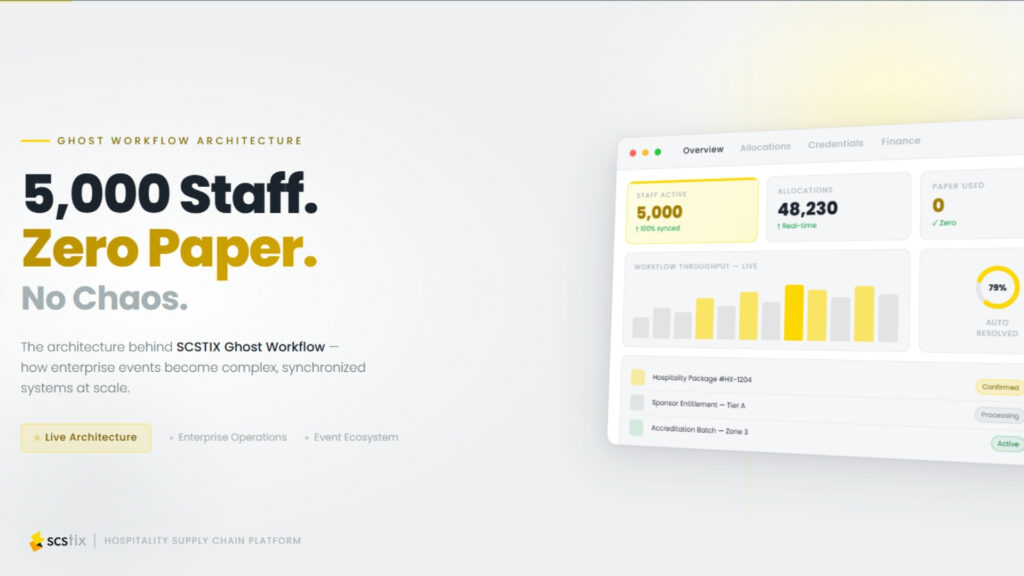
When Events Become Complex Systems
Large scale events are no longer isolated productions. They are complex commercial ecosystems.
A global tournament.
A multi-city championship.
A high-profile hospitality program.
A recurring international event series.
These environments involve far more than ticket sales. They involve layered sponsor entitlements, agency allocations, VIP guest management, accreditation control, financial approvals, and operational fulfilment across multiple dates and stakeholders.
At a smaller scale, teams can coordinate through email and spreadsheets. At enterprise scale, those methods begin to fracture. Information duplicates. Allocations drift. Approvals stall inboxes. Teams operate with partial visibility of what is happening elsewhere in the event structure.
The result is not always visible in chaos. It is friction. Delays. Commercial risk. Uncertainty at the exact moment of precision is required.
This is where architecture matters.
What We Call a Ghost Workflow
At SCSTIX, we describe the solution as a Ghost Workflow.
It is our way of defining an event operating model where commercial and operational processes move automatically, without manual relays between teams.
In a Ghost Workflow, when a hospitality package is confirmed, inventory adjusts instantly across the event ecosystem. Entitlement allocations update in real time across rights holders, partners, agencies, and internal stakeholders. Financial workflows initiate. Credential permissions activate according to predefined hierarchies. Every movement is logged and governed.
No confirmation email is forwarded to the next team.
No data is re-entered into another system.
No one questions which allocation file is correct.
The workflow becomes invisible. The control becomes absolute.
The 3 Pillars of Ghost Architecture
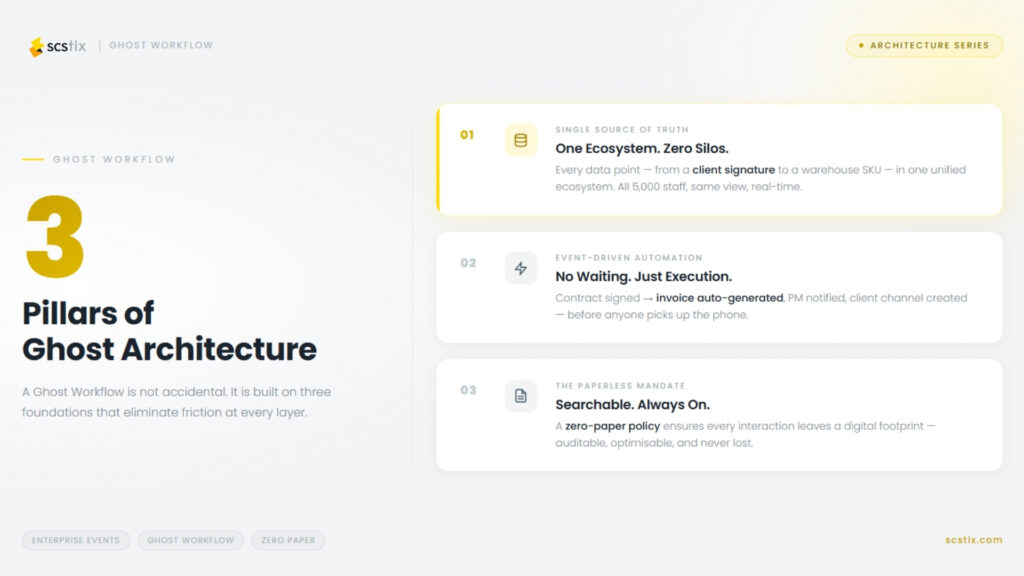
A Ghost Workflow is not accidental. It is built on three architectural foundations.
1. The Single Source of Truth (SSoT)
Chaos thrives in silos. If the Sales team is using one spreadsheet and the Operations team is using another, the workflow is already broken.
- The Architecture: Every piece of data (from a client signature to a warehouse SKU) must live in a unified digital ecosystem.
- The Result: No more “Where is the latest version of this?” Every one of your 5,000 staff members sees the same data at the same time.
2. Event-Driven Automation
A Ghost Workflow doesn’t wait for a human to click “Next.” It is triggered by events.
- The Process: When a contract is digitally signed, the system automatically generates an invoice, notifies the project manager, and creates a dedicated communication channel for the client.
- Why it matters: It eliminates the lag between tasks, reduces manual handoffs between teams, and ensures that execution begins the moment a decision is confirmed.
3. The Paperless Mandate
Going paperless isn’t just about the environment; it’s about searchability and security.
- The Architecture: Physical documents are static and dead. Digital data is dynamic and searchable. By enforcing a zero-paper policy, you ensure that every interaction leaves a digital footprint that can be analyzed and optimized.
- Moving From Chaos to Clarity
Transitioning 5,000 staff members into this model requires more than just new software. It requires a shift in culture. You aren’t just “buying an app.” You are re-engineering how workflows through your building.
Why Event Ecosystems Break Down
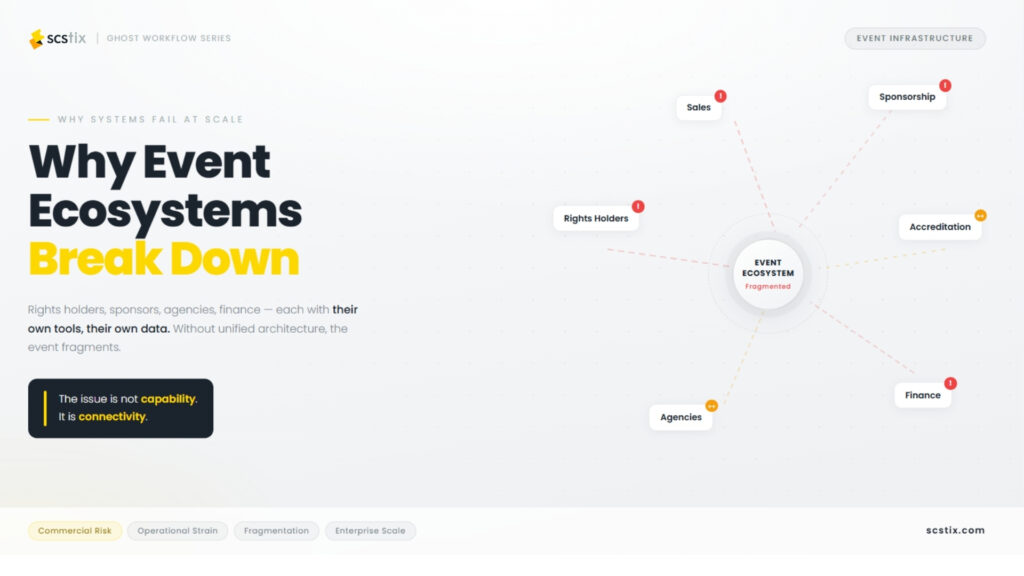
Major events bring together rights holders, organizing committees, sponsors, agencies, accreditation teams, hospitality operators, and finance departments. Each group has its own priorities and its own tools.
Without unified architecture, the event begins to fragment. Sales may operate from one allocation view while accreditation relies on exported lists. Sponsorship teams manage entitlements separately from inventory. Finance reconciles numbers that do not always match operational reality.
The issue is not capability. It is connectivity.
In high value event environments, disconnected systems introduce commercial risk and operational strain.
The larger the event, the greater the pressure.
From Event Management to Event Architecture
Implementing this model is not about adding another software platform. It is about reengineering how the event moves.
When inventory, allocations, permissions, and reporting are unified, commercial teams stop chasing updates. Accreditation teams stop reconciling static lists. Finance stops correcting mismatched reports.
The operational burden shifts from coordination to execution.
The event becomes synchronized.
The friction disappears.
That is the essence of a Ghost Workflow.
Where SCSTIX Fits
SCSTIX is a hospitality supply chain and inventory management platform built specifically for complex event ecosystems. It centralizes premium ticket inventory, hospitality package configuration, sponsor and agency allocation control, multi-channel sales, accreditation governance, and real time reporting across the full event lifecycle.
Rather than operating through disconnected tools, organizers operate through a structured, unified architecture designed for scale.
That unified architecture is what we call a Ghost Workflow.
The Bottom Line
When thousands of staff operate across a global event, chaos is not caused by size. It is caused by fragmentation.
With the right architecture in place, inventory synchronizes. Approvals trigger automatically. Credentials activate securely. Commercial and operational teams align without constant manual intervention.
Technology fades into the background.
The event takes center stage.
If your next event involves layered hospitality programs, multi-stakeholder allocations, accreditation governance, and enterprise-level reporting, it may be time to rethink your operating architecture.
See how SCSTIX powers Ghost Workflows for complex event ecosystems –https://scstix.com/